
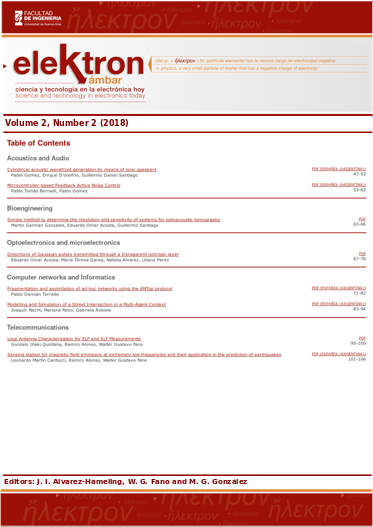
Modelling and Simulation of a Street Intersection in a Multi-Agent Context
DOI:
https://doi.org/10.37537/rev.elektron.2.2.59.2018Keywords:
multi-agent systems, agent-oriented programming, traffic, NetLogoAbstract
Losses of time due to congestion and traffic jams are current events in cities due to a non-optimal configuration of the traffic lights. Various sciences and specialties have tried to understand the phenomenon and identify the causes in order to obtain an appropriate solution. The present work introduces the extension of a system oriented to agents whose purpose is to reduce the waiting time of the drivers in an intersection of streets; modelling now vehicles (cars and taxis), pedestrians and an intelligent traffic light that evaluates the weights of the flows in two directions (X and Y), turn left and right. For which, the validation was carried out in six possible scenarios, defined by means of the variation of the flow of vehicles and pedestrians, of a turning frequency in 20 and 80 and the application of different adjustment factors for intelligent traffic lights. The simulation environment was implemented in NetLogo, which allowed comparing the impact of the use of the intelligent traffic light versus a fixed-time traffic light. Finally, we will present the conclusions and future work.Downloads
References
J. Long, Z. Gao, H. Ren, and A. Lian. Urban traffic congestion propagation and bottleneck identification. Science in China Series F: Information Sciences, 51(7), 948-964, 2008.
A. M. Rao, and K. R. Rao. Measuring Urban Traffic Congestion-A Review. International Journal for Traffic & Transport Engineering, 2(4), 2012.
F. Tan, J. Wu, Y. Xia, and K. T. Chi. Traffic congestion in interconnected complex networks. Physical Review E, 89(6), 062813, 2014.
J. A. Lindley. Urban freeway congestion: quantification of the problem and effectiveness of potential solutions. ITE journal, 57(1), 27-32, 1987.
R. Bauza, and J. Gozálvez, J. Traffic congestion detection in large-scale scenarios using vehicle-to-vehicle communications. Journal of Network and Computer Applications, 36(5), 1295-1307, 2013.
P. Lopez-Garcia, E. Onieva, E. Osaba, A. D. Masegosa, and A. Perallos. A hybrid method for short-term traffic congestion forecasting using genetic algorithms and cross entropy. IEEE Transactions on Intelligent Transportation Systems, 17(2), 557-569, 2016.
D. A. Hennessy, and D. L. Wiesenthal. Traffic congestion, driver stress, and driver aggression. Aggressive behavior, 25(6), 409-423, 1999.
R. Putha, L. Quadrifoglio, and E. Zechman. Comparing ant colony optimization and genetic algorithm approaches for solving traffic signal coordination under oversaturation conditions. Computer‐Aided Civil and Infrastructure Engineering, 27(1), 14-28, 2012.
D. Teodorović, and M. Dell’Orco. Mitigating traffic congestion: solving the ride-matching problem by bee colony optimization. Transportation Planning and Technology, 31(2), 135-152, 2008.
A. L. Bazzan, and F. Klügl. A review on agent-based technology for traffic and transportation. The Knowledge Engineering Review, 29(3), 375-403, 2014.
B. Chen, and H. H. Cheng. A review of the applications of agent technology in traffic and transportation systems. IEEE Transactions on Intelligent Transportation Systems, 11(2), 485-497, 2010.
P. A. Ehlert, and L. J. Rothkrantz. Microscopic traffic simulation with reactive driving agents. In Intelligent Transportation Systems, 2001. Proceedings. 2001 IEEE (pp. 860-865). IEEE, 2001.
S. Tisue, and U. Wilensky. NetLogo: Design and implementation of a multi-agent modeling environment. In Proceedings of agent, vol. 2004, pp. 7-9.
R. J. Allan. Survey of agent based modelling and simulation tools (pp. 1362-0207). Science & Technology Facilities Council, 2010.
T. F. Battolla, S. Fuentes, J. I. Illi, J. Nacht, M. Falco, G. Pezzuchi, and G. Robiolo. Sistema dinámico y adaptativo para el control del tráfico de una intersección de calles: modelación y simulación de un sistema multi-agente. En: Simposio Argentino de Inteligencia Artificial (ASAI) – Jornadas Argentinas de Informática, Universidad de Palermo, Septiembre de 2018.
S. F. Smith, G. J. Barlow, X. F. Xie, and Z. B. Rubinstein. Smart Urban Signal Networks: Initial Application of the SURTRAC Adaptive Traffic Signal Control System. In ICAPS 2013.
T. Nagatani. Vehicular traffic through a sequence of green-wave lights. Physica A: Statistical Mechanics and its Applications, 380, 503-511, 2007.
K. H. N. Bui, J. E. Jung, and D. Camacho. Game theoretic approach on Real‐time decision making for IoT‐based traffic light control. Concurrency and Computation: Practice and Experience, 29(11), 2017.
K. H. N. Bui, D. Camacho, and J. E. Jung. Real-time traffic flow management based on inter-object communication: a case study at intersection. Mobile Networks and Applications, 22(4), 613-624, 2017.
F. Daneshfar, J. RavanJamJah, F. Mansoori, H. Bevrani, and B. Z. Azami. Adaptive fuzzy urban traffic flow control using a cooperative multi-agent system based on two stage fuzzy clustering. In Vehicular Technology Conference, 2009. VTC Spring 2009. IEEE 69th (pp. 1-5). IEEE, 2009.
J. C. Burguillo-Rial, P. S. Rodríguez-Hernández, E. C. Montenegro, and F. G. Castiñeira. History-based self-organizing traffic lights. Computing and Informatics, 28(2), 157-168, 2012.
A. Guerrero-Ibanez, J. Contreras-Castillo, R. Buenrostro, A. B. Marti, and A. R. Muñoz. A policy-based multi-agent management approach for intelligent traffic-light control. In Intelligent Vehicles Symposium (IV), 2010 IEEE, pp. 694-699. IEEE.
S. Abar, G. K. Theodoropoulos, P. Lemarinier, and G. M. O’Hare. Agent based modelling and simulation tools: a review of the state-of-art software. Computer Science Review, 24, 13-33, 2017,
M. Wooldridge. An introduction to multiagent systems. John Wiley & Sons, 2009.
A. Zeid, A UML Profile for Agent-Based Development, in: Lecture Notes in Computer Science, vol. 2641, 2003, pp. 161–170.
E. Bonabeau. Agent-based modeling: Methods and techniques for simulating human systems. Proceedings of the National Academy of Sciences, 99 (suppl 3), 7280-7287, 2002.
A. Banos, C. Lang, and N. Marilleau. Agent-based spatial simulation with NetLogo, vol. 1, Elsevier, 2015.
U. Wilensky, and W. Rand. An introduction to agent-based modeling: modeling natural, social, and engineered complex systems with NetLogo. MIT Press, 2015.
Downloads
Published
Issue
Section
License
The authors who publish in this journal agree with terms established in the license Attribution-NonCommercial-NoDerivatives 4.0 International (CC BY-NC-ND 4.0)


