
MOS devices for dosimetry applications
DOI:
https://doi.org/10.37537/rev.elektron.10.1.237.2026Keywords:
Radiation effects, MOS devices, MOS dosimetryAbstract
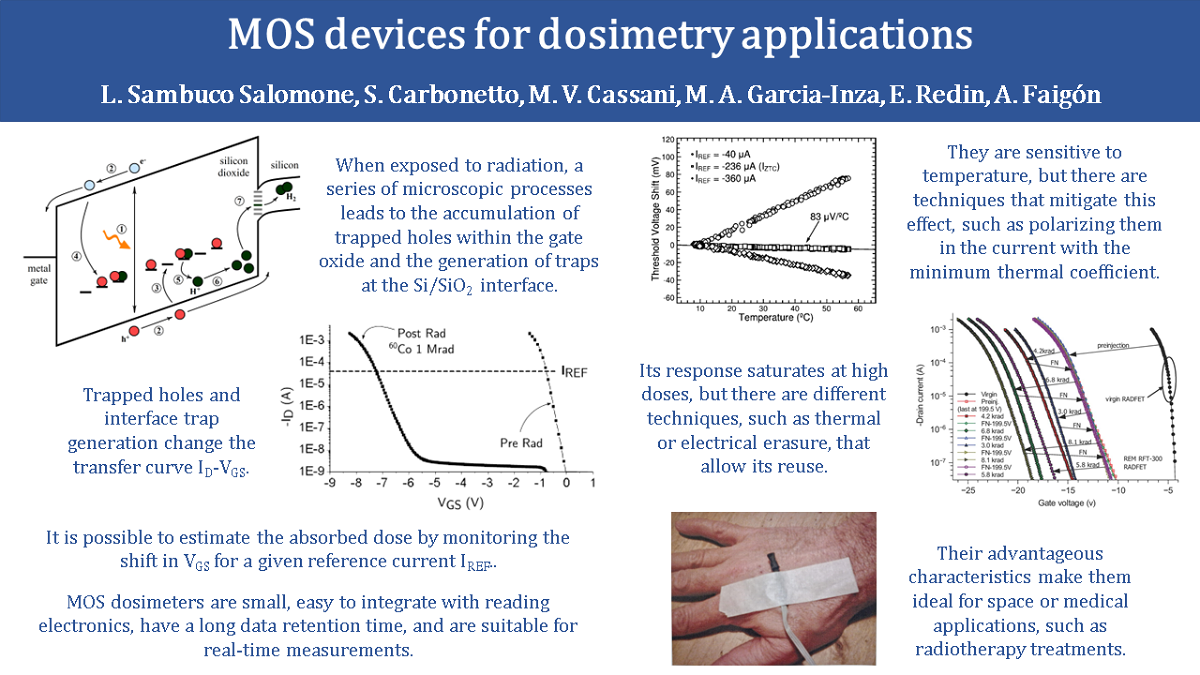
This work presents a review of MOS dosimetry from its physical principles up to the most recent developments. The limitations of MOS dosimeters are analyzed and the usually considered solutions are described. MOS dosimeters based on alternative structures, such as floating gate devices, are also discussed.
Downloads
References
[1] J. R. Kopacz, R. Herschitz, and J. Roney, “Small satellites an overview and assessment,” Acta Astronautica, vol. 170, pp. 93-105, 2020, doi: https://doi.org/10.1016/j.actaastro.2020.01.034.
[2] R. Velazco, D. McMorrow, and J. Estela (Eds.), “Radiation effects on integrated circuits and systems for space applications,” Springer, 2019.
[3] J. Mazur, L. Friesen, A. Lin, D. Mabry, N. Katz, Y. Dotan, J. George, J. B. Blake, M. Looper, M. Redding, T. P. O’Brien, J. Cha, A. Birkitt, P. Carranza, M. Lalic, F. Fuentes, R. Galvan, and M. McNab, “The relativistic proton spectrometer (RPS) for the radiation belt storm probes mission,” Space Science Reviews, vol. 179, pp. 221-261, 2013, doi: https://doi.org/10.1007/s11214-012-9926-9.
[4] J. E. Mazur, T. P. O’Brien, and M. D. Looper, “The relativistic proton spectrometer: A review of sensor performance, applications, and science,” Space Science Reviews, vol. 219, no. 3, p. 26, 2023, doi: https://doi.org/10.1007/s11214-023-00962-2.
[5] H. Zhao, W. R. Johnston, D. N. Baker, X. Li, B. Ni, A. N. Jaynes, S. G. Kanekal, J. B. Blake, S. G. Claudepierre, G. D. Reeves, and A. J. Boyd, “Characterization and evolution of radiation belt electron energy spectra based on the Van Allen probes measurements,” Journal of Geophysical Research: Space Physics, vol. 124, pp. 4217-4232, 2019, doi: https://doi.org/10.1029/2019JA026697.
[6] A. W. Strong, E. Orlando, and T. R. Jaffe, “The interstellar cosmic-ray electron spectrum from synchrotron radiation and direct measurements,” Astronomy and Astrophysics, vol. 354, p. A54, 2011, doi: https://doi.org/10.1051/0004-6361/201116828.
[7] “Comprehensive QA for radiation oncology,” American Association of Physicists in Medicine, report N46, 1994.
[8] “In vivo dosimetry,” ASN Patient Safety, no. 5, 2014.
[9] L. Brualla, M. Rodriguez, J. Sempau, and P. Andreo, “PENELOPE/PRIMO-calculated photon and electron spectra from clinical accelerators,” Radiation Oncology, vol. 14, no. 1, p. 6, 2019, doi: https://doi.org/10.1186/s13014-018-1186-8.
[10] P. Papagiannis, A. Angelopoulos, E. Pantelis, L. Sakelliou, P. Karaiskos, and Y. Shimizu, “Monte Carlo dosimetry of 60Co HDR brachytherapy sources,” Medical Physics, vol. 30, no. 4, pp. 712-721, 2003, doi: https://doi.org/10.1118/1.1563662.
[11] R. Nath, L. L. Anderson, G. Luxton, K. A. Weaver, J. F. Williamson, and A. S. Meigooni, “Dosimetry of interstitial brachytherapy sources: Recommendations of the AAPM Radiation Therapy Committee Task Group No. 43,” Medical Physics, vol. 22, no. 2, pp. 209-234, 1995, doi: https://doi.org/10.1118/1.597458.
[12] R. Mohan, “A review of proton therapy – Current status and future prospects,” Precision Radiation Oncology, vol. 6, no. 2, pp. 164-176, 2022, doi: https://doi.org/10.1002/pro6.1149.
[13] G. A. Ausman, and F. B. McLean, “Electron-hole pair creation in SiO2,” Harry Diamond Laboratories Technical Report, HDL-TR-1720, 1975.
[14] J. M. Benedetto, and H. E. Boesch, “The relationship between 60Co and 10-keV X-ray damage in MOS devices,” IEEE Transactions on Nuclear Science, vol. 33, no. 6, pp. 1318-1323, 1986, doi: https://doi.org/10.1109/TNS.1986.4334599.
[15] T. R. Oldham, and J. M. McGarrity, “Ionization of SiO2 by heavy charged particles,” IEEE Transactions on Nuclear Science, vol. 28, no. 6, pp. 3975-3980, 1981, doi: https://doi.org/10.1109/TNS.1981.4335658.
[16] T. R. Oldham, “Recombination along the tracks of heavy charged particles in SiO2 films,” Journal of Applied Physics, vol. 57, no. 8, pp. 2695-2702, 1985, doi: https://doi.org/10.1063/1.335409.
[17] H. E. Boesch, and J. M. McGarrity, “Charge yield and dose effects in MOS capacitors at 80 K,” IEEE Transactions on Nuclear Science, vol. 23, no. 6, pp. 1520-1525, 1976, doi: https://doi.org/10.1109/TNS.1976.4328532.
[18] T. R. Oldham, and J. M. McGarrity, “Comparison of 60Co response and 10 keV X-ray response in MOS capacitors,” IEEE Transactions on Nuclear Science, vol. 30, no. 6, pp. 4377-4381, 1983, doi: https://doi.org/10.1109/TNS.1983.4333141.
[19] F. B. McLean, and T. R. Oldham, “Basic mechanisms of radiation effects in electronic materials and devices,” Harry Diamond Laboratory, Tech. Rep., HDL-TR-2129.
[20] C. M. Dozier, D. M. Fleetwood, D. B. Brown, and P. S. Winokur, “An evaluation of low-energy X-ray and cobalt-60 irradiations of MOS transistors,” IEEE Transactions on Nuclear Science, vol. 34, no. 6, pp. 1535-1539, 1987, doi: https://doi.org/10.1109/TNS.1987.4337511.
[21] R. J. Krantz, L. W. Aukerman, and T. C. Zietlow, “Applied field and total dose dependence of trapped charge buildup in MOS devices,” IEEE Transactions on Nuclear Science, vol. 34, no. 6, pp. 1196-1201, 1987, doi: https://doi.org/10.1109/TNS.1987.4337452.
[22] R. C. Hughes, “Hot electrons in SiO2,” Physical Review Letters, vol. 35, no. 7, pp. 449-452, 1975, doi: https://doi.org/10.1103/PhysRevLett.35.449.
[23] M. V. Fischetti, D. J. DiMaria, S. D. Brorson, T. N. Theis, and J. R. Kirtley, “Theory of high-field electron transport in silicon dioxide,” Physical Review B, vol. 31, no. 12, pp. 8124-8142, 1985, doi: https://doi.org/10.1103/PhysRevB.31.8124.
[24] O. L. Curtis, and J. R. Srour, “The multiple-trapping model and hole transport in SiO2,” Journal of Applied Physics, vol. 48, no. 9, pp. 3819-3828, 1977, doi: https://doi.org/10.1063/1.324248.
[25] M. Schaffman, M. Silver, C. Corthell, and R. C. Hughes, “Simulations of the transient photoconductivity in a-SiO2 using a multiple-trap model,” Journal of Applied Physics, vol. 51, no. 1, pp. 490-494, 1979, doi: https://doi.org/10.1063/1.327349.
[26] F. B. McLean, H. E. Boesch, and J. M. McGarrity, “Hole transport and recovery characteristics of SiO2 gate insulators,” IEEE Transactions on Nuclear Science, vol. 23, no. 6, pp. 1506-1512, 1976, doi: https://doi.org/10.1109/TNS.1976.4328530.
[27] F. B. McLean, H. E. Boesch, and J. M. McGarrity, “Dispersive hole transport in SiO2,” Harry Diamond Laboratories Report, HDL-TR-2117, 1987.
[28] P. M. Lenahan, and P. V. Dressendorfer, “Hole traps and trivalent silicon centers in metal/oxide/silicon devices,” Journal of Applied Physics, vol. 55, no. 10, pp. 3495-3499, 1984, doi: https://doi.org/10.1063/1.332937.
[29] Y. Y. Kim, and P. M. Lenahan, “Electron-spin-resonance study of radiation-induced paramagnetic defects in oxides grown on (100) silicon substrates,” Journal of Applied Physics, vol. 64, no. 7, pp. 3551-3557, 1988, doi: https://doi.org/10.1063/1.341494.
[30] E. H. Poindexter, P. Caplan, B. E. Deal, and R. R. Razouk, “Interface states and electron spin resonance centers in thermally oxidized (111) and (100) silicon wafers,” Journal of Applied Physics, vol. 52, no. 2, pp. 879-884, 1981, doi: https://doi.org/10.1063/1.328771.
[31] P. M. Lenahan, K. L. Brower, and P. V. Dressendorfer, “Radiation-induced trivalent silicon defect buildup at the Si-SiO2 interface in MOS structures,” IEEE Transactions on Nuclear Science, vol. 28, no. 6, pp. 4105-4106, 1981, doi: https://doi.org/10.1109/TNS.1981.4335683.
[32] F. B. McLean, “A framework for understanding radiation-induced interface states in SiO2 MOS structures,” IEEE Transactions on Nuclear Science, vol. 27, no. 6, pp. 1651-1657, 1980, doi: https://doi.org/10.1109/TNS.1980.4331084.
[33] M. R. Shaneyfelt, J. R. Schwank, D. M. Fleetwood, P. S. Winokur, K. L. Hughes, and F. W. Sexton, “Field dependence of interface-trap buildup in polysilicon and metal gate MOS devices,” IEEE Transactions on Nuclear Science, vol. 37, no. 6, pp. 1632-1640, 1990, doi: https://doi.org/10.1109/23.101171.
[34] R. García Cozzi, E. Redín, M. Garcia-Inza, L. Sambuco Salomone, A. Faigón, S. Carbonetto, “Influence of interface traps on MOSFETs thermal coefficients and its effects on the ZTC current,” Microelectronics Reliability, vol. 137, 114752, 2022, doi: https://doi.org/10.1016/j.microrel.2022.114752.
[35] D. M. Fleetwood, and J. H. Scofield, “Evidence that similar point defects cause 1/f noise and radiation-induced-hole trapping in metal-oxide-semiconductor transistors,” IEEE Transactions on Nuclear Science, vol. 64, no. 5, pp. 579-582, 1990, doi: https://doi.org/10.1103/PhysRevLett.64.579.
[36] T. L. Meisenheimer, and D. M. Fleetwood, “Effect of radiation-induced charge on 1/f noise in MOS devices,” IEEE Transactions on Nuclear Science, vol. 37, no. 6, pp. 1696-1702, 1990, doi: https://doi.org/10.1109/23.101179.
[37] T. L. Meisenheimer, D. M. Fleetwood, M. R. Shaneyfelt, and L. C. Riewe, “1/f noise in n- and p-channel MOS devices through irradiation and annealing,” IEEE Transactions on Nuclear Science, vol. 38, no. 6, pp. 1297-1303, 1991, doi: https://doi.org/10.1109/23.124108
[38] A. Scarpa, A. Paccagnella, F. Montera, G. Ghibaudo, G. Pananakakis, G. Ghidini, and P. G. Fuochi, “Ionizing radiation induced leakage current on ultra-thin gate oxides,” IEEE Transactions on Nuclear Science, vol. 44, no. 6, pp. 1818-1825, 1997, doi: https://doi.org/10.1109/23.658948
[39] M. Ceschia, A. Paccagnella, A. Cester, A. Scarpa, and G. Ghidini, “Radiation induced leakage current and stress induced leakage current in ultra-thin gate oxides,” IEEE Transactions on Nuclear Science, vol. 45, no. 6, pp. 2375-2382, 1998, doi: https://doi.org/10.1109/23.736457
[40] M. Ceschia, A. Paccagnella, M. Turrini, A. Candelori, G. Ghidini, and J. Wyss, “Heavy ion irradiation of thin gate oxides,” IEEE Transactions on Nuclear Science, vol. 47, no. 6, pp. 2648-2655, 2000, doi: https://doi.org/10.1109/23.903821
[41] P. M. Lenahan, J. P. Campbell, A. Y. Kang, S. T. Liu, and R. A. Weimer, “Radiation-induced leakage currents: Atomic scale mechanisms,” IEEE Transactions on Nuclear Science, vol. 48, no. 6, pp. 2101-2106, 2001, doi: https://doi.org/10.1109/23.983179
[42] R. C. Lacoe, “CMOS scaling design principles and hardening by design methodology,”NSREC Shrot Course, 2003
[43] W. J. Poch, and A. G. Holmes-Siedle, “The mosimeter: A new instrument for measuring radiation dose,” RCA Engineer, vol. 16, no. 3, pp. 56-59, 1970.
[44] A. Holmes-Siedle, “The space-charge dosimeter: General principles of a new method of radiation detection,” Nuclear Instruments and Methods, vol. 121, no. 1, pp. 169-179, 1974 doi: https://doi.org/10.1016/0029-554X(74)90153-0
[45] A. Holmes-Siedle, L. Adams, J. S. Leffler, and S. R. Lindgren, “The RADFET system for real-time dosimeter in nuclear facility,” IEEE Transactions on Nuclear Science, vol. 26, 025004, 1983
[46] A. G. Holmes-Siedle, L. Adams, B. Pauly, and S. Marsden, “Linearity of pMOS radiation dosimeters operated at zero bias,” Electronics Letters, vol. 21, no. 3, pp. 570-571, 1985, doi: https://doi.org/10.1049/el:19850403
[47] A. Holmes-Siedle, and L. Adams, “RADFET: A review of the use of metal-oxide-silicon devices as integrating dosimeters,” Radiation Physics and Chemistry, vol. 28, no. 2, pp. 235-244, 1986, doi: https://doi.org/10.1016/1359-0197(86)90134-7
[48] F. Ravotti, M. Glaser, M. Moll, C. Ilgner, B. Camanzi, and A. G. Holmes-Siedle, “Response of RadFET dosimeters to high fluence of fast neutrons,” IEEE Transactions on Nuclear Science, vol. 52, no. 4, pp. 959-965, 2005, doi: https://doi.org/10.1109/TNS.2005.852709
[49] A. Holmes-Siedle, F. Ravotti, and M. Glaser, “The dosimetric performance of RADFETs in radiation test beams,” IEEE Radiation Effects Data Workshop, pp. 42-57, 2007, doi: https://doi.org/10.1109/REDW.2007.4342539
[50] F. Vettese, C. Donichak, P. Bourgeault, and G. Sarrabayrouse, “Assessment of a new p-MOSFET usable as a dose rate insensitive gamma dose sensor,” IEEE Transactions on Nuclear Science, vol. 43, no. 3, pp. 991-996, 1996, doi: https://doi.org/10.1109/23.510745
[51] L. J. Asensio, M. A. Carvajal, J. A. López-Villanueva, M. Vilches, A. M. Lallena, and A. J. Palma, “Evaluation of a low-cost commercial MOSFET as a radiation dosimeter,” Sensors and Actuators A, vol. 125, pp. 288-295, 2006, doi: https://doi.org/10.1016/j.sna.2005.08.020
[52] A. Haran, A. Jaksić, N. Refaeli, A. Eliyahu, D. David, and J. Barak, “Temperature effects and long term fading of implanted and unimplanted gate oxide RADFETs,” IEEE Transactions on Nuclear Science, vol. 51, no. 5, pp. 2917-2921, 2004, doi: https://doi.org/10.1109/TNS.2004.835065
[53] RFT300-CC10G1 Datasheet (RFTDAT-CC10 - Rev W), REM Oxford Ltd., 2010.
[54] G. Pablo Cirrone, G. Cuttone, P. A. Lojacono, S. L. Nigro, I. V. Patti, S. Pittera, L. Raffaele, M. G. Sabini, V. Salamone, and L. M. Valastro, “Preliminary investigation on the use of the MOSFET dosimeter in proton beams,” Phys. Med., vol. 22, no. 1, pp. 29-32, 2006, doi: https://doi.org/10.1016/S1120-1797(06)80008-6
[55] R. Kohno, K. Hotta, T. Matsuura, K. Matsubara, S. Nishioka, T. Nishio, M. Kawashima, and T. Ogino, “Proton dose distribution measurements using a MOSFET detector with a simple dose-weighted correction method for let effects,” J. Appl. Clin. Med. Phys., vol. 12, no. 2, 2011, doi: https://doi.org/10.1120/jacmp.v12i2.3431
[56] S. Ruiz-Arrebola, R. Fabregat-Borrás, E. Rodríguez, M. Fernández-Montes, M. Pérez-Macho, M. Ferri, A. García, J. Cardenal, M. T. Pacheco, and J. Anchuelo, “Characterization of microMOSFET detectors for in vivo dosimetry in high-dose-rate brachytherapy with 192Ir,” Medical Physics, vol. 47, no. 5, pp. 2242-2253, 2020, doi: https://doi.org/10.1002/mp.14080
[57] A. Sadeghi, B. Prestidge, J. M. Lee, I. Jurkovic, M. Simms, W. Bice, E. Walker, “Clinical use of a linear array MOSFET for urethral dose verification in prostate high dose rate brachytherapy,” ABS 27th annual Meeting, poster paper, 2006.
[58] VT02 Datasheet (Rev. 2.2), Varadis, 2022.
[59] Z.-Y. Qi, X.-W. Deng, S.-M. Huang, L. Zhang, Z.-C. He, X. A. Li, I. Kwan, M. Lerch, D. Cutajar, P. Metcalfe, and A. Rosenfeld, “In vivo verification of superficial dose for head and neck treatments using intensity-modulated techniques,” Medical Physics, vol. 36, no. 1, pp. 59-70, 2008, doi: https://doi.org/10.1118/1.3030951
[60] J. Cayley, E. Engels, T. Charles, P. Bennetto, M. Cameron, J. Poder, D. Hausermann, J. Paino, D. Butler, D. Cutajar, M. Petasecca, A. Rosenfeld, Y.-R. E. Tan, and M. Lerch, “Establishing linearity of the MOSkin detector for ultra-high dose-per-pulse, very-high-energy electron radiotherapy using dose-rate-corrected EBT-XD film,” Applied Sciences, vol. 15, no. 14, p. 8101, 2025, doi: https://doi.org/10.3390/app15148101
[61] P. H. Halvorsen, “Dosimetric evaluation of a new design MOSFET in vivo dosimeter,” Medical Physics, vol. 32, no. 1, pp. 110-117, 2005, doi: https://doi.org/10.1118/1.1827771
[62] R. A. Kinhikar, P. K. Sharma, C. M. Tambe, U. M. Mahantshetty, R. Sarin, D. D. Deshpande, and S. K. Shrivastava, “Clinical application of a OneDoseTM MOSFET for skin dose measurements during internal mammary chain irradiation with high dose rate brachytherapy in carcinoma of the breast,” Physics in Medicine and Biology, vol. 51, N263-N268, 2006, doi: https://doi.org/10.1088/0031-9155/51/14/N01
[63] G. X. Ding, and C. W. Coffey, “Dosimetric evaluation of the OneDoseTM MOSFET for measuring kilovoltage imaging dose from image-guided radiotherapy procedures,” Medical Physics, vol. 37, no. 9, pp. 4880-4885, 2010, doi: https://doi.org/10.1118/1.3483099
[64] T. Cheung, M. J. Butson, and P. K. N. Yu, “Effects of temperature variation on MOSFET dosimetry,” Physics in Medicine and Biology, vol. 49, N191-N196, 2004, doi: https://doi.org/10.1088/0031-9155/49/13/N02
[65] S. H. Carbonetto, M. A. García Inza, J. Lipovetzky, E. G. Redin, L. Sambuco Salomone, and A. Faigón, “Zero temperature coefficient bias in MOS devices. Dependence on interface traps density, application to MOS dosimetry,” IEEE Transactions on Nuclear Science, vol. 58, no. 6, pp. 3348-3353, 2011, doi: https://doi.org/10.1109/TNS.2011.2170430
[66] M. Soubra, J. Cygler, and G. MacKay, “Evaluation of a dual bias metal oxide-silicon semiconductor field effect transistor detector as radiation dosimeter,” Medical Physics, vol. 21, no. 4, pp. 567-572, 1994, doi: https://doi.org/10.1118/1.597314
[67] S. Carbonetto, M. Garcia-Inza, J. Lipovetzky, M. Carra, E. Redin, L. Sambuco Salomone, and A. Faigon, “CMOS differential and amplified dosimeter with field oxide n-channel MOSFETs,” IEEE Transactions on Nuclear Science, vol. 61, no. 6, pp. 3466-3471, 2014, doi: https://doi.org/10.1109/TNS.2014.2368361
[68] M. Garcia-Inza, S. H. Carbonetto, J. Lipovetzky, and A. Faigon, “Radiation sensor based on MOSFETs mismatch amplification for radiotherapy applications,” IEEE Transactions on Nuclear Science, vol. 63, no. 3, pp. 1784-1789, 2016, doi: https://doi.org/10.1109/TNS.2016.2560172
[69] S. Carbonetto, M. Echarri, J. Lipovetzky, M. Garcia-Inza, and A. Faigón, “Temperature-compensated MOS dosimeter fully integrated in a high-voltage 0.35 μm CMOS process,” IEEE Transactions on Nuclear Science, vol. 67, no. 6, pp. 1118-1124, 2020, doi: https://doi.org/10.1109/TNS.2020.2966567
[70] H. E. Boesch, Jr., F. B. McLean, J. M. Benedetto, J. M. McGarrity, and W. E. Bailey, “Saturation of threshold voltage shift in MOSFET’s at high total dose,” IEEE Transactions on Nuclear Science, vol. 33, no. 6, pp. 1191-1197, 1986, doi: https://doi.org/10.1109/TNS.1986.4334577
[71] E. H. Snow, A. S. Grove, and D. J. Fitzgerald, “Effects of ionizing radiation on oxidized silicon surfaces and planar devices,” Proceedings of the IEEE, vol. 55, no. 7, pp. 1168-1185, 1967, doi: https://doi.org/10.1109/PROC.1967.5776
[72] A. Kelleher, N. McDonnell, B. O’Neill, and W. Lane, “Investigation into re-use of PMOS dosimeters,” IEEE Transactions on Nuclear Science, vol. 41, no. 3, pp. 445-451, 1994, doi: https://doi.org/10.1109/23.299782
[73] A. Kelleher, W. Lane, and L. Adams, “Investigation of on-chip high temperature annealing of PMOS dosimeters,” IEEE Transactions on Nuclear Science, vol. 43, no. 3, pp. 997-1001, 1996, doi: https://doi.org/10.1109/RADECS.1995.509821
[74] G. Ristic, “Thermal and UV annealing of irradiated pMOS dosimetric transistors,” Journal of Physics D: Applied Physics, vol. 42, 135001, 2009, doi: https://doi.org/10.1088/0022-3727/42/13/135101
[75] E. Yilmaz, and R. Turan, “Temperature cycling of MOS-based radiation sensors,” Sensors and Actuators, vol. 141, pp. 1-5, 2008, doi: https://doi.org/10.1016/j.sna.2007.07.001
[76] L. Sambuco Salomone, M. V. Cassani, M. Garcia-Inza, A. Faigón, S. Carbonetto, and E. Redin, “Preliminary results of the thermal annealing for MOS dosimeters reutilization,” 2025 Argentine Conference on Electronics (CAE), IEEE, pp. 82-86, 2025, doi: https://doi.org/10.1109/CAE64243.2025.10961957
[77] D. Verellen, S. Van Vaerenbergh, K. Tournel, K. Heuninckx, L. Joris, M. Duchareau, N. Linthout, T. Gevaert, T. Reynders, I. Van de Vondel, L. Coppens, T. Depuydt, M. De Ridder, and G. Storme, “An in-house developed resettable MOSFET dosimeter for radiotherapy,” Physics and Biology, vol. 55, pp. 97-109, 2010, doi: https://doi.org/10.1088/0031-9155/55/4/N01
[78] G.-W. Luo, Z.-Y. Qi, X.-W. Deng, and A. Rosenfeld, “Investigation of a pulsed current annealing method in reusing MOSFET dosimeters for in vivo IMRT dosimetry,” Medical Physics, vol. 41, no. 5, 051710, 2014, doi: https://doi.org/10.1118/1.4871619
[79] Y. Nissan-Cohen, J. Shappir, and D. Frohman-Bentchkowsky, “Dynamic model of trapping-detrapping in SiO2,” Journal of Applied Physics, vol. 58, no. 6, pp. 2252-2261, 1985, doi: https://doi.org/10.1063/1.335942
[80] D. J. DiMaria, E. Cartier, and D. Arnold, “Impact ionization, trap creation, degradation, and breakdown in silicon dioxide films on silicon,” Journal of Applied Physics, vol. 73, no. 7, pp. 3367-3384, 1993, doi: https://doi.org/10.1063/1.352936
[81] D. Arnold, E. Cartier, and D. J. DiMaria, “Theory of high-field electron transport and impact ionization in silicon dioxide,” Physical Review B, vol. 49, no. 15, pp. 10278-10297, 1994, doi: https://doi.org/10.1103/PhysRevB.49.10278
[82] E. Miranda, E. Redin, and A. Faigon, “An effective field approach for the Fowler-Nordheim tunneling current through a metal-oxide-semiconductor charged barrier,” Journal of Applied Physics, vol. 82, no. 3, pp. 1262-1265, 1997, doi: https://doi.org/10.1063/1.366535
[83] J. Lipovetzky, E. G. Redin, and A. Faigon, “Electrically erasable metal-oxide-semiconductor dosimeters,” IEEE Transactions on Nuclear Science, vol. 54, no. 4, pp. 1244-1250, 2007, doi: https://doi.org/10.1109/TNS.2007.895122
[84] J. Lipovetzky, A. Holmes-Siedle, M. García Inza, S. Carbonetto, E. Redin, and A. Faigon, “New Fowler-Nordheim injection, charge neutralization, and gamma tests on the REM RFT300 RADFET dosimeter,” IEEE Transactions on Nuclear Science, vol. 59, no. 6, pp. 3133-3140, 2012, doi: https://doi.org/10.1109/TNS.2012.2222667
[85] D. M. Fleetwood, “Radiation induced charge neutralization and interface trap buildup in metal oxide semiconductor devices,” Journal of Applied Physics, vol. 67, no. 1, pp. 580-583, 1990, doi: https://doi.org/10.1063/1.345199
[86] A. Faigon, J. Lipovetzky, E. Redin, and G. Krusczenski, “Extension of the measurement range of MOS dosimeters using radiation induced charge neutralization,” IEEE Transactions on Nuclear Science, vol. 55, no. 4, pp. 2141-2147, 2008, doi: https://doi.org/10.1109/TNS.2008.2000767
[87] J. Lipovetzky, E. G. Redin, M. A. García Inza, S. Carbonetto, and A. Faigón, “Reducing measurement uncertainties using bias cycled measurement in MOS dosimetry at different temperatures,” IEEE Transactions on Nuclear Science, vol. 57, no. 2, pp. 848-853, 2010, doi: https://doi.org/10.1109/TNS.2010.2042178
[88] P. J. McWhorter, S. L. Miller, and W. M. Miller, “Modeling the anneal of radiation-induced trapped holes in a varying thermal environment,” IEEE Transactions on Nuclear Science, vol. 37, no. 6, pp. 1682-1689, 1990, doi: https://doi.org/10.1109/23.101177
[89] G. F. Derbenwick, and B. L. Gregory, “Process optimization of radiation-hardened CMOS integrated circuits,” IEEE Transactions on Nuclear Science, vol. 22, no. 6, pp. 2151-2156, 1975, doi: https://doi.org/10.1109/TNS.1975.4328096
[90] C. R. Viswanathan, and J. Maserjian, “Model for thickness dependence of radiation charging in MOS structures,” IEEE Transactions on Nuclear Science, vol. 23, no. 6, pp. 1540-1545, 1976, doi: https://doi.org/10.1109/TNS.1976.4328535
[91] N. S. Saks, M. G. Ancona, and J. A. Modolo, “Radiation effects in MOS capacitors with very thin oxides at 80 K,” IEEE Transactions on Nuclear Science, vol. 31, no. 6, pp. 1249-1255, 1984, doi: https://doi.org/10.1109/TNS.1984.4333491
[92] J. Lipovetzky, M. Garcia-Inza, S. Carbonetto, M. J. Carra, E. G. Redin, L. Sambuco Salomone, and A. Faigon, “Field oxide n-channel MOS dosimeters fabricated in CMOS processes,” IEEE Transactions on Nuclear Science, vol. 60, no. 6, pp. 4683-4691, 2013, doi: https://doi.org/10.1109/TNS.2013.2287256
[93] T. R. Oldham, A. J. Lelis, H. E. Boesch, J. M. Benedetto, F. B. McLean, and J. M. McGarrity, “Post-irradiation effects in field-oxide isolation structures,” IEEE Transactions on Nuclear Science, vol. 34, no. 6, pp. 1184-1189, 1987, doi: https://doi.org/10.1109/TNS.1987.4337450
[94] J. M. Terrell, T. R. Oldham, A, J. Lelis, and J. M. Benedetto, “Time dependent annealing of radiation-induced leakage currents in MOS devices,” IEEE Transactions on Nuclear Science, vol. 36, no. 6, pp. 2205-2211, 1989, doi: https://doi.org/10.1109/23.45426
[95] I. Sanchez Esqueda, H. J. Barnaby, K. E. Holbert, and Y. Boulghassoul, “Modeling inter-device leakage in 90 nm bulk CMOS devices,” IEEE Transactions on Nuclear Science, vol. 58, no. 3, pp. 793-799, 2011, doi: https://doi.org/10.1109/TNS.2010.2101616
[96] M. Garcia-Inza, M. Cassani, S. Carbonetto, M. Casal, E. Redin, and A. Faigon, “6 MV LINAC characterization of a MOSFET dosimeter fabricated in a CMOS process,” Radiation Measurements, vol. 117, pp. 63-69, 2018, doi: https://doi.org/10.1016/j.radmeas.2018.07.009
[97] J. Kassabov, N. Nedev, and N. Smirnov, “Radiation dosimeter based on floating gate MOS transistor,” Radiation Effects and Defects in Solids, vol. 116, no. 1-2, pp. 155-158, 1991, doi: https://doi.org/10.1080/10420159108221354
[98] C. J. Peters, N. G. Tarr, K. Shortt, I. Thomson, and G. F. MacKay, “A floating-gate MOSFET gamma dosimeter,” Canadian Journal of Physics, vol. 74, no. 12, pp. 135-138, 1996, doi: https://doi.org/10.1139/p96-846
[99] N. G. Tarr, G. F. MacKay, K. Shortt, and I. Thomson, “A floating gate MOSFET dosimeter requiring no external bias supply,” IEEE Transactions on Nuclear Science, vol. 45, no. 3, pp. 1470-1474, 1998, doi: https://doi.org/10.1109/RADECS.1997.698909
[100] N. G. Tarr, K. Shortt, Y. Wang, and I. Thomson, “A sensitive, temperature-compensated, zero-bias floating gate MOSFET dosimeter,” IEEE Transactions on Nuclear Science, vol. 51, no. 3, pp. 1277-1282, 2004, doi: https://doi.org/10.1109/TNS.2004.829372
[101] M. Martin, D. Roth, A. Garrison-Darrin, P. McNulty, and A. Andreou, “FGMOS dosimetry: Design and implementation,” IEEE Transactions on Nuclear Science, vol. 48, no. 6, pp. 2050-2055, 2001, doi: https://doi.org/10.1109/23.983171
[102] M. García Inza, J. Lipovetzky, E. G. Redin, S. Carbonetto, and A. Faigón, “Floating gate pMOS dosimeters under bias controlled cycled measurement,” IEEE Transactions on Nuclear Science, vol. 58, no. 3, pp. 808-812, 2011, doi: https://doi.org/10.1109/TNS.2010.2099668
[103] E. Garcia-Moreno, E. Isern, M. Roca, R. Picos, J. Font, J. Cesari, and A. Pineda, “Floating gate CMOS dosimeter with frequency output,” IEEE Transactions on Nuclear Science, vol. 59, no. 2, pp. 373-378, 2012, doi: https://doi.org/10.1109/TNS.2012.2184301
[104] E. Garcia-Moreno, E. Isern, M. Roca, R. Picos, J. Font, J. Cesari, and A. Pineda, “Temperature compensated floating gate MOS radiation sensor with current output,” IEEE Transactions on Nuclear Science, vol. 60, no. 5, pp. 4026-4030, 2013, doi: https://doi.org/10.1109/TNS.2013.2277605
[105] E. G. Villani, A. Gabrielli, A. Khan, E. Pikhay, Y. Roizin, and Z. Zhang, “Monolithic 180 nm CMOS dosimeter for in vivo medical applications,” IEEE Transactions on Nuclear Science, vol. 60, no. 2, pp. 843-849, 2013, doi: https://doi.org/10.1109/TNS.2013.2251472
[106] E. G. Villani, M. Crepaldi, D. DeMarchi, A. Gabrielli, A. Khan, E. Pikhay, Y. Roizin, A. Rosenfeld, and Z. Zhang, “A monolithic 180 nm CMOS dosimeter for wireless in vivo dosimetry,” Radiation Measurements, vol. 84, pp. 55-64, 2016, doi: https://doi.org/10.1016/j.radmeas.2015.11.004
[107] M. Brucoli, S. Danzeca, M. Brugger, A. Masi, A. Pineda, J. Cesari, L. Dusseau, and F. Wrobel, “Floating gate dosimeter suitability for accelerator-like environments,” IEEE Transactions on Nuclear Science, vol. 64, no. 8, pp. 2054-2060, 2017, doi: https://doi.org/10.1109/TNS.2017.2681651
[108] C. Zhang, and S. M. Rezaul Hasan, “A new floating-gate radiation sensor and readout circuit in standard single-poly 130-nm CMOS technology,” IEEE Transactions on Nuclear Science, vol. 66, no. 7, pp. 1906-1915, 2019, doi: https://doi.org/10.1109/TNS.2019.2922714
[109] T. Darós, N. C. Cábia, J. Piteira, and M. C. Schneider, “Design, modeling, and characterization of a floating gate dosimeter in standard CMOS technology for sensor reuse,” IEEE Transactions on Nuclear Science, vol. 72, no. 2, pp. 3069-3076, 2025, doi: https://doi.org/10.1109/TNS.2025.3594306
[110] L. Z. Scheick, P. J. McNulty, and D. R. Roth, “Dosimetry based on the erasure of floating gates in the natural radiation environments in space,” IEEE Transactions on Nuclear Science, vol. 45, no. 6, pp. 2681-2688, 1998, doi: https://doi.org/10.1109/23.736515
[111] P. J. McNulty, M. Rajaman, K. F. Poole, K. R. Freeman, J. P. Dyar, L. Z. Scheick, M. Alkhafazi, and M. G. Randall, “Simplified readout of UVPROM dosimeters for spacecraft applications,” IEEE Transactions on Nuclear Science, vol. 53, no. 4, pp. 1859-1862, 2006, doi: https://doi.org/10.1109/TNS.2006.877564
[112] P. J. McNulty, and K. F. Poole, “Increasing the sensitivity of FGMOS dosimeters by reading at higher temperature,” IEEE Transactions on Nuclear Science, vol. 59, no. 4, pp. 1113-1116, 2012, doi: https://doi.org/10.1109/TNS.2012.2192288
[113] R. Edgecock, J. Matheson, M. Weber, E. G. Villani, R. Bose, A: Khan, D. R. Smith, I. Adil-Smith, and A. Gabrielli, “Evaluation of commercial programmable floating gate devices as radiation dosimeters,” Journal of Instrumentation, vol. 4, no. 2, pp. 1-10, 2009, doi: https://doi.org/10.1088/1748-0221/4/02/P02002
[114] S. Ilić, A. Jevtić, S. Stanković, and G. Ristić, “Floating-gate MOS transistor with dynamic biasing as a radiation sensor,” Sensors, vol. 20, no. 11, p. 3329, 2021, doi: https://doi.org/10.3390/s20113329
[115] S. Ilić, M. S. Andjelković, R. Duane, A. J. Palma, M. Sarajlić, S. Stanković, and G. R. Ristić, “Recharging process of commercial floating-gate MOS transistor in dosimetry application,” Microelectronics Reliability, vol. 126, p. 114322, 2022, doi: https://doi.org/10.1016/j.microrel.2021.114322
Published
Data Availability Statement
As a review article, there is no data that can be shared.
Issue
Section
License
Copyright (c) 2026 Lucas Sambuco Salomone, Sebastián Carbonetto, María Victoria Cassani, Mariano Andrés Garcia-Inza, Eduardo Redin, Adrián Faigón

This work is licensed under a Creative Commons Attribution-NonCommercial-NoDerivatives 4.0 International License.
The authors who publish in this journal agree with terms established in the license Attribution-NonCommercial-NoDerivatives 4.0 International (CC BY-NC-ND 4.0)

How to Cite