
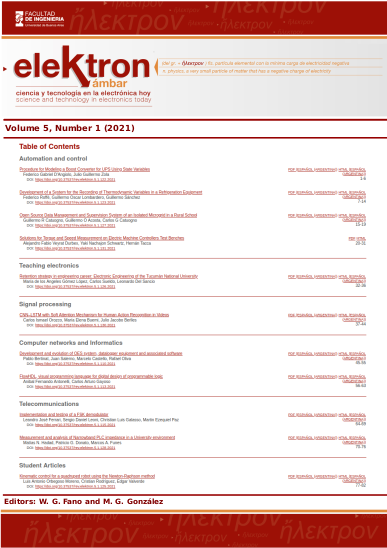
Measurement and analysis of Narrowband PLC impedance in a University environment
DOI:
https://doi.org/10.37537/rev.elektron.5.1.128.2021Keywords:
Narrowband PLC, Impedance, Measurement CampaignAbstract
Narrowband powerline communication systems are widely used in many applications, such as smart metering devices, home automation and low-speed command and control systems. However, power lines were not designed for data transmission and they represent a harsh environment for communication. In the specific bibliography, it is possible to find studies that show the diverse issues of Narrowband Powerline Communication, being the impedance of the grid one of them. The main objective of the present work is to provide a study on the impedance of the grid over this communication band. This study was done in a University environment which has a diverse number of unknown loads, considering the variation with time and location. The data acquisition system developed to conduct the study is shown. The analysis of the results shows that the local grid exhibits issues as least as severe as the ones presented by other authors in different countries and environments.Downloads
References
S. Galli, A. Scaglione, and Z. Wang, “For the grid and through the grid: The role of power line communications in the smart grid,” Proceedings of the IEEE, vol. 99, no. 6, pp. 998–1027, June 2011.
“IEEE standard for low-frequency (less than 500 khz) narrowband power line communications for smart grid applications,” IEEE Std 1901.2-2013, pp. 1–269, Dec 2013.
“IEEE standard for low-frequency (less than 500 khz) narrowband power line communications for smart grid applications - amendment 1,” IEEE Std 1901.2a-
N. Andreadou and G. Fulli, “NB-PLC channel: Estimation of periodic impulsive noise parameters and mitigation techniques,” International Journal of Electrical Power and Energy Systems, vol. 103, pp. 146 – 158, 2018. [Online]. Available: http://www.sciencedirect.com/science/article/pii/S0142061517332143.
M. Nassar, J. Lin, Y. Mortazavi, A. Dabak, I. H. Kim, and B. L. Evans, “Local utility power line communications in the 3–500 kHz band: Channel impairments, noise, and standards,” IEEE Signal Processing Magazine, vol. 29, no. 5, pp. 116–127, Sep. 2012.
L. G. da S. Costa, G. R. Colen, A. C. M. de Queiroz, V. L. da Costa, U. R. Vitor, F. V. dos Santos, and M. V. Ribeiro, “Access impedance in brazilian in-home, broadband and low-voltage electric power grids,” Electric Power Systems Research, vol. 171, pp. 141 – 149, 2019. [Online]. Available: http://www.sciencedirect.com/science/article/pii/S037877961930080X.
H. Mahamudul and C. Ozansoy, “L-C band pass impedance matching coupling circuit for high voltage PLC applications,” International Journal of Electrical Power & Energy Systems, vol. 117, p. 105639, may 2020.
“Signalling on low-voltage electrical installations in the frequency 3 khz to 148,5 khz part 1: General requirements, frequency bands and electromagnetic disturbances,” CENELEC EN 50065-1, 2011.
“Instituto de investigaciones científicas y tecnológicas en electrónica,” http://icyte.fi.mdp.edu.ar.
P. A. Janse van Rensburg, M. P. Sibanda, and H. C. Ferreira, “Integrated impedance-matching coupler for smart building and other power-line communications applications,” IEEE Transactions on Power Delivery, vol. 30, no. 2, pp. 949–956, 2015.
“AFE design for a narrowband power-line communications modem using the AFE031,” http://www.ti.com/lit/pdf/sboa130.
I. Cavdar and K. Engin, “Measurements of impedance and attenuation at CENELEC bands for power line communications systems,” Sensors, vol. 8, 12 2008.
J. Cortés, A. Sanz, P. Estopiñán, and J. Garcia, “Analysis of narrowband power line communication channels for advanced metering infrastructure,” EURASIP Journal on Advances in Signal Processing, vol. 2015, 03 2015.
J. Bausch, T. Kistner, M. Babic, and K. Dostert, “Characteristics of indoor power line channels in the frequency range 50 - 500 khz,” in 2006 IEEE International Symposium on Power Line Communications and Its Applications, March 2006, pp. 86–91.
Downloads
Published
Issue
Section
License
The authors who publish in this journal agree with terms established in the license Attribution-NonCommercial-NoDerivatives 4.0 International (CC BY-NC-ND 4.0)

How to Cite